
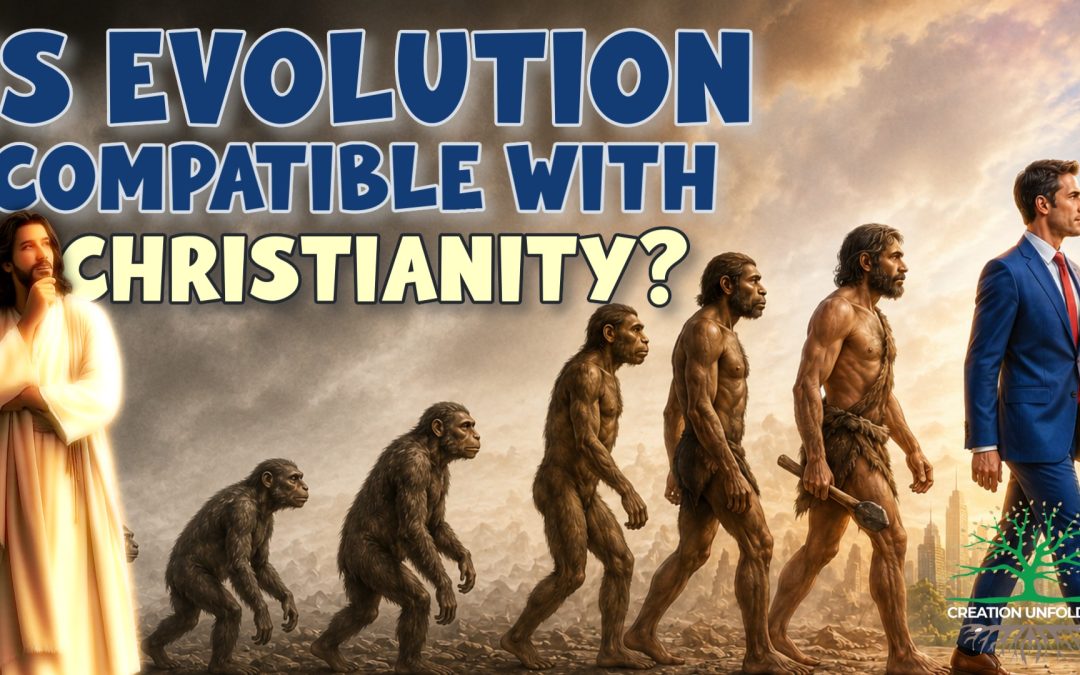
In his book “the evolution of Adam,” theistic evolutionist Pete Enns rejects the historicity of Adam and, in fact, the entire Fall account as it is recorded in the early chapters of Genesis, opting instead for a literary, mythical figure that never actually existed. As a committed evolutionist, Enns also believes that molecules-to-man evolution is not only true, but that it is completely compatible with the Bible’s teachings on sin, death, and the gospel. But is that true?
[Prefer video format. No worries! Check out the video on this blog below!]
Well, let’s start with physical death. As an evolutionist, Enns believes that death is a natural process that, over the past 3 billion years or so, has shaped organismic diversity and complexity by capitalizing on every conceivable biological weakness. We call this natural selection, where the fittest and most compliant creaturely adaptations thrive at the expense of adaptational inferiority and weakness.
Listen to Enns as he defines death from his evolutionary worldview, “But death is not the unnatural state introduced by a disobedient couple in a primordial garden. Actually, it is the means that promotes the continued evolution of life on this planet and even ensures workable population numbers. Death may hurt, but it is evolution’s ally.”[1] Just keep that definition in mind as we move forward.
Now let’s look at sin. According to Enns, sin is likewise connected to evolutionary mechanisms of change that induce selfish, self-preservatory behaviors associated with the evolutionary survival of our species over the past several millions of years.
And, of course, this is where things get really tricky. Given Enns’ beliefs about the origin of sin and death, one wonders how he can continue to make statements such as this, “In other words, attributing the cause of universal sin and death to a historical Adam is not necessary for the gospel of Jesus Christ to be a historical solution to that problem. To put it positively, as Paul says, we all need the Savior to deliver us from sin and death. That Christian conviction, as I see it, is unaffected by this entire discussion.”[2]
Yet this reasoning is fallacious. This is because Enns’ construal of the words “sin” and “death” in this quote have very little to do with the way Jesus, Paul, or in fact, any other Bible writer understood them.
First, in the Bible, sin and death are irrevocably linked in various metaphysical ways. The most apparent connection between sin and death is that death is always preceded by sin. Here is but a scattering of a theme that literally permeates Scripture, In Genesis 2:17 we read, “for in the day that you eat of it [i.e., when you sin] you shall surely die.” Note that sin is first and then death. In Ezekiel 18:20 we read, “The soul who sins shall die.” Sin is first, and then death. Jesus, in John 8:24 says; “I told you that you would die in your sins, for unless you believe that I am he you will die in your sins.” It is quite clear that Jesus is saying their sins will kill them. Paul in Romans 5:12 says, “Therefore, just as sin came into the world through one man, and death through sin” and then again in Romans 6:23 he says, “the wages of sin is death.” Sin is first, then death. Paul also says in 1 Corinthians 15:21, “For as by a man came death.” Sin is first, then death. This pattern is consistent throughout the entire Bible.
The problem is that, according to Enns’ evolutionary beliefs, physical death has absolutely nothing to do with sin. Death was first. In a very real sense, the evolutionary narrative turns death on its biblical head by categorically affirming that death gives birth to life over billions of years of toil, pain, and suffering. And what about sin, when did it enter the picture? Well, since sins are acts of rebellion, and since rebellious choices can only be made by moral beings then it was physical death, through the agency of Darwinian evolution and the survival of the fittest, that eventually gave rise to “sin.” Yet this is all backwards and would certainly have been the furthest thing from the minds of every single Bible writer. Paul is adamant about this, “the sting of death is sin” (1 Corinthians 15:56). Sin was first, then death.
Although secular, unbelieving scientists might talk of “sin” as the breaking of moral laws, they will in no way connect this behavior to physical death. Why? Because they already “know” that physical death is the product of Darwinian evolutionary mechanisms—as does Enns. I trust the fog is starting to lift here.
As it turns out, it is not only physical death that is the product of sin. The Bible plainly links sin to disease, natural disasters, and national calamity. Paul says that some of the Corinthians are sick, and some even died physically, because of their sin. For the same reason, national Israel suffered agricultural loss. In Hosea 4:13, God says:
“Hear the word of the Lord, O children of Israel, for the Lord has a controversy with the inhabitants of the land. There is no faithfulness or steadfast love, and no knowledge of God in the land; there is swearing, lying, murder, stealing, and committing adultery; they break all bounds, and bloodshed follows bloodshed. Therefore the land mourns, and all who dwell in it languish, and also the beasts of the field and the birds of the heavens, and even the fish of the sea are taken away.” And the idea of “taken away” here means in judgment.
Now this and multiple other examples like this in Scripture have got nothing to do with direct anthropomorphic misdeeds such as environmental mismanagement. Rather, the metaphysical act of sin caused a corresponding metaphysical response in nature (death). This kind of relationship between sin and death, which is fully unpacked in Scripture has got nothing to do with Enns’ evolutionary beliefs, but is crucial to the way in which death atones for sin, especially as it relates to the substitutionary atonement of Christ on the cross.
And this brings us full circle as we once again ponder Enns’ syncretistic views. Let’s listen to Enns’ quote again, “To put it positively, as Paul says, we all need the Savior to deliver us from sin and death. That Christian conviction, as I see it, is unaffected by this entire discussion [about whether or not Adam existed].”[3]
The problem with this statement, given everything that’s been said above, is that it necessarily holds to two clashing explanatory systems at the same time. In Enns’ model, death does not have any metaphysical redeeming mettle. As such, physical death cannot atone for sin which makes Christ’s atoning death on the cross metaphysically meaningless.
[1] Enns, Peter. The evolution of Adam: what the Bible does and doesn’t say about human origins (Brazos Press, 2021), 199.
[2] Enns, Evolution of Adam, 117.
[3] Enns, Evolution of Adam, 117.
